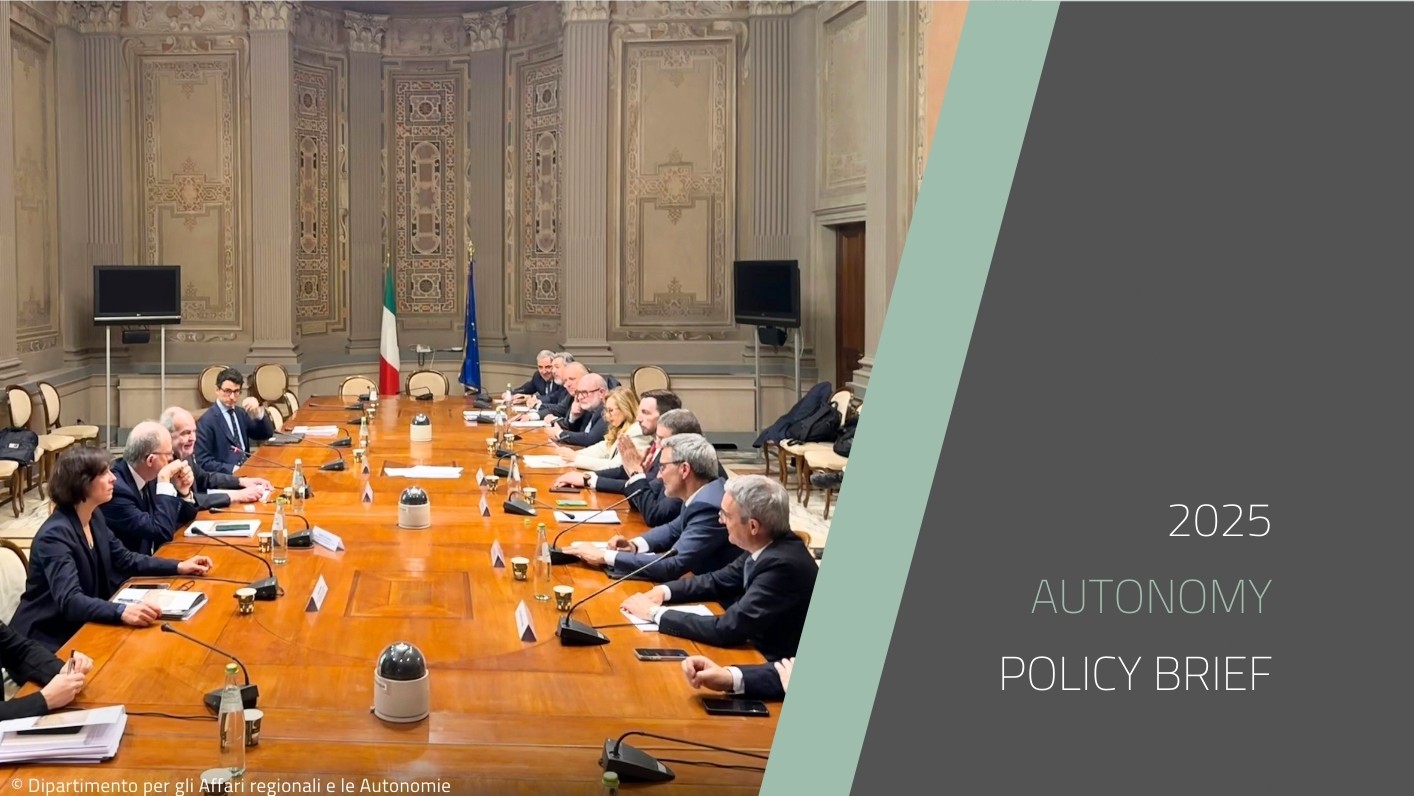
The Autonomy Policy Brief 2025 analyses the latest autonomy developments in South Tyrol. The topics addressed include, among others, the municipal elections, the autonomy reform, two new enactment decrees, developments in the fields of bilingualism and trilingualism, education and financial policy.
Current statistics on South Tyrol, its autonomy and minority protection can be found on the Autonomy Dashboard South Tyrol (https://www.autonomy-dashboard.info).
All links were verified on 6 December 2025.
Published on 6 December 2025
Authors: Jakob Volgger, Marc Röggla
Politics and elections
Elections
In May 2025, municipal councils were newly elected in 111 of South Tyrol’s 116 municipalities. The Südtiroler Volkspartei currently holds 103 mayoral offices. Voter turnout reached 60 percent, representing a decrease of 5.4 percentage points compared to the 2020 municipal elections. In Stilfs/Stelvio, new elections were held in November following the death of the incumbent mayor.
National media paid particular attention to the transfer of office in Meran/Merano, where Katharina Zeller succeeded her predecessor, Dario Dal Medico. During the handover ceremony, Dal Medico draped the mayoral sash in the Italian tricolour over Zeller’s shoulders, which she subsequently removed. The gesture was criticised by some Italian media outlets and political parties, who interpreted it as an act of disrespect towards the Italian flag.
In the nationwide referendum on labour law and citizenship held in June, the required turnout threshold of 50 percent was not reached in South Tyrol. This was also the case in the rest of Italy. Voter turnout in the province stood at only about 16 percent. Among the Italian regions, Trentino-South Tyrol recorded the lowest turnout, at 22.7 percent.
Provincial Government
Provincial Councillor Christian Bianchi announced in January that he was leaving the Lega to join Forza Italia. This change altered the composition in the Provincial Council of South Tyrol: Bianchi had previously been the only representative of the Lega and is now the sole representative of Forza Italia. The move also meant a shift within the governing coalition. However, both Bianchi and Forza Italia reaffirmed their support for the government programme and remain part of the coalition.
Austrian politics
As South Tyrol’s protecting power, Austria and its political developments are of central importance for the province. In March 2025, a new Austrian government was sworn in, composed of the Österreichische Volkspartei, the Sozialdemokratische Partei and the NEOS (Das Neue Österreich und Liberales Forum). The government programme makes explicit reference to South Tyrol: “It is the shared responsibility of Austria and Italy to guarantee the autonomous development of South Tyrol and, in close coordination with the representatives of the German- and Ladin-speaking groups in South Tyrol, to further develop its autonomy.” The programme also emphasises the “engagement of the ORF [Austrian Broadcasting Corporation] in and from South Tyrol”.
In a resolution, the majority of the National Council reaffirmed Austria’s commitment to supporting South Tyrol in the reform of the Autonomy Statute. The subcommittee of the National Council’s Foreign Affairs Committee dealing with South Tyrol has not yet been established.
Law
Revision of the Autonomy Statute
After negotiations on the revision of the Autonomy Statute of the Autonomous Region of Trentino-Alto Adige/Südtirol were launched last year (see Autonomy Policy Brief 2024), the corresponding draft constitutional law was approved by the Italian Council of Ministers on 9 April. This was followed by a series of procedural steps, which are presented in Table 1.
Table 1: Procedural steps in the revision of the Autonomy Statute in 2025
| Date | Event |
| 12 April | The Minister for Regional Affairs and Autonomies, Roberto Calderoli, transmits the draft constitutional law to the President of South Tyrol, Arno Kompatscher. Kompatscher forwards the text to the President of the Provincial Council of South Tyrol, who then distributes it to all members of the Provincial Council. |
| 22 April | At the request of all opposition parties in the Provincial Council of South Tyrol, an extraordinary session is convened. The opposition calls for a vote on the individual provisions of the draft constitutional law, which, however, is not foreseen under the applicable rules. As a result, opposition members leave the chamber of the Provincial Council in protest. |
| 23 April | The Special Committee for the Examination of Proposals to Amend the Autonomy Statute of the Provincial Council issues a positive opinion on the draft constitutional law, with 28 votes in favour. The following groups in the Provincial Council vote in favour: Die Freiheitlichen, Forza Italia/Uniti per l’Alto Adige, Fratelli d’Italia, Für Südtirol mit Widmann, Grüne Fraktion/Gruppo verde/Grupa vërda, La Civica, Partito Democratico/Demokratische Partei, Team K, Südtiroler Volkspartei, Wir Bürger/Noi Cittadini/Nëus Zitadins. Those voting against are JWA Wirth Anderlan, Süd-Tiroler Freiheit, Vita. The Freie Fraktion abstains. |
| 7 May | The Provincial Council of South Tyrol adopts a positive opinion on the draft constitutional law by majority vote, following the recommendation of the Special Committee (26 votes in favour, 6 against). The Provincial Council of Trentino also adopts a positive opinion (33 votes in favour, 1 abstention). |
| 14 May | The Regional Council of Trentino-Alto Adige/Südtirol endorses the decisions of the two Provincial Councils and issues a positive opinion on the draft constitutional law (54 votes in favour, 6 against, 1 abstention). |
| 29 May | The Permanent Conference for Relations between the State, the Regions and the Autonomous Provinces of Trento and Bolzano/Bozen issues a positive opinion on the draft constitutional law. |
| 12 June | The so-called Commission 137 – named after measure no. 137 of the so-called “Package”, which provided for the establishment of a standing commission for matters concerning the Province of Bolzano/Bozen – issues a positive opinion on the revision of the Autonomy Statute. Subsequently, the Italian Council of Ministers approves the draft constitutional law unanimously. |
| 24 September | The Constitutional Affairs Committee of the Chamber of Deputies approves the draft constitutional law, which it received for review on 19 June. |
| 7 October | The Chamber of Deputies approves the draft constitutional law in its first reading. Of the 400 deputies, 224 participate in the vote: 192 vote in favour, 32 abstain, and there are no votes against. All proposed amendments are rejected. |
| 26 November | The Constitutional Affairs Committee of the Senate approves the draft constitutional law, which it receives for review on 16 October. |
The details of the revision of the Autonomy Statute are explained in the Autonomy Policy Brief 2025/1. At present, the timetable foresees that the second reading and subsequent votes in Parliament could take place in the second half of 2026. Supporters aim to have the constitutional law adopted during the current legislative term, and thus by 2027 at the latest.
Enactment decrees of the Autonomy Statute
In June 2025, a new enactment decree entered into force (Legislative Decree of 12 June 2025, no. 97). It allows state administrations operating in South Tyrol, in exceptional cases, to deviate from the ethnic quota system, that is, from the distribution of public jobs according to the size of the language groups. The deviation is subject to the following requirements: It applies exclusively to fixed-term positions and only if “at least 10 per cent of the positions allocated on the basis of the quota calculation remain unfilled”. A deviation is only permitted for up to 50 per cent of the unfilled posts within the respective job profile. For these fixed-term positions, the requirement for proof of bilingualism and the language group declaration or affiliation may be waived. The provision applies to employment contracts concluded within five years from the entry into force of the enactment decree.
At the beginning of December, the Council of Ministers approved another enactment decree. An amendment to the existing enactment decree in the field of energy was introduced. The Autonomous Provinces of Bolzano/Bozen and Trento now have the option of extending the expiry date of electricity distribution concessions beyond 31 December 2030, provided an investment plan of up to twenty years is approved in line with national regulations.
On the basis of the enactment decrees on volunteer work adopted in the previous year, a provincial law establishing a dedicated provincial register of “organisations carrying out activities of general interest” was adopted this year with a cross-party majority of 28 votes in favour. The aim of the law is, among other things, to reduce the administrative burden on voluntary organisations.
Language, language groups and society
Language barometer of South Tyrol
While the results of the 2023/2024 language group census allow only limited conclusions to be drawn about the linguistic reality of South Tyrolean society, the study “Südtiroler Sprachbarometer/Barometro linguistico dell’Alto Adige” published this year by ASTAT provides important data in this regard. Table 2 presents, among other information, respondents’ stated sense of belonging to a linguistic group as well as their declared mother tongue. Around 9 per cent of respondents indicated two or more mother tongues. As a result, the total number of declared mother tongues (111 per cent) exceeds the number of residents.
Table 2: Persons by sense of belonging to a language group and mother tongue, 2025 (ASTAT, Südtiroler Sprachbarometer/Barometro linguistico dell’Alto Adige 2025, p. 14)
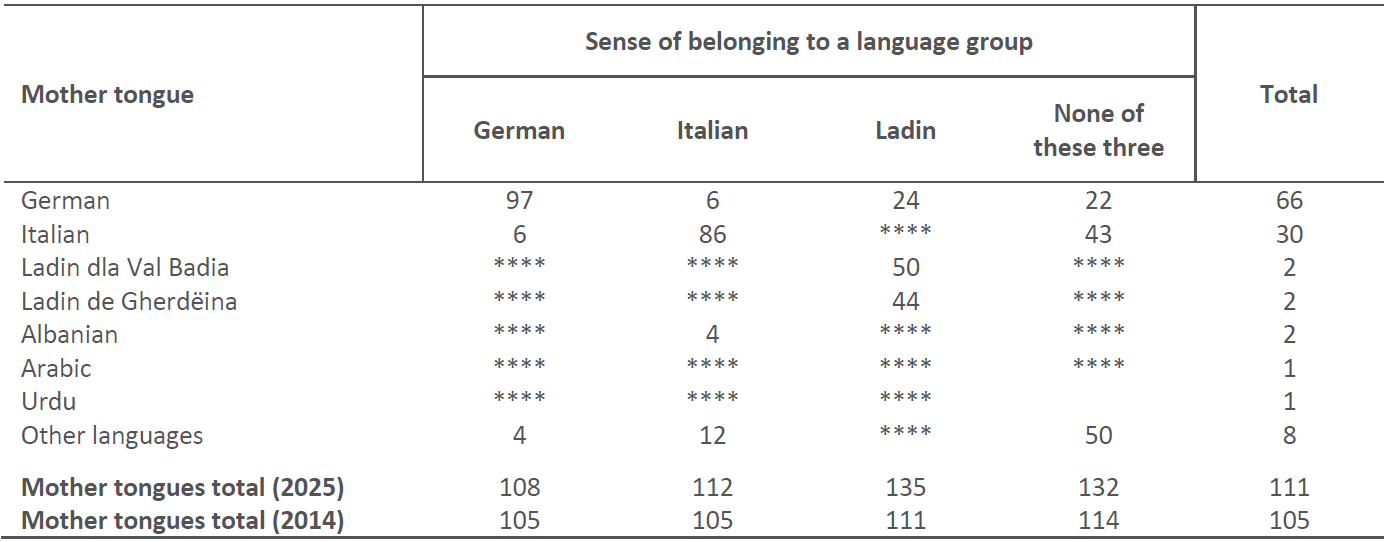
Four asterisks (****) indicate insufficient estimation accuracy.
Bilingualism and trilingualism
The issue of bilingualism and trilingualism within the South Tyrolean Health Authority continues to be a recurring political topic. According to Hubert Messner, Provincial Councillor for Healthcare and Health, 449 employees of the Health Authority did not hold a bilingualism certificate as of March 2025. Particular attention was drawn to the case of two doctors at the Bozen/Bolzano hospital who had submitted falsified language certificates in order to move from fixed-term contracts to permanent positions. The fraud was uncovered when the Office for Official Languages and Civil Rights identified the certificate as forged. In response, the Office tightened its checks on applications for the recognition of the bilingualism certificate. In September it became known that a further 25 submitted language certificates had been falsified (23 concerning German language proficiency and 2 concerning Italian). Ten of these cases involved the South Tyrolean Health Authority. The individuals concerned were dismissed with immediate effect. Additional investigations by the Public Prosecutor’s Office are ongoing. The incidents also sparked political debate: While some called for longer deadlines for obtaining the bilingualism certificates, others stressed that permanent employment in the public administration should continue to require a valid certificate.
To facilitate access to the bilingualism test, it is now possible to sit the test in Bruneck/Brunico and Rome as of December. In Bruneck/Brunico, candidates may also sit the Ladin tests.
Bilingualism is also relevant to state authorities. In South Tyrol, individuals have the right to communicate with the police forces in either German or Italian. Although the Carabinieri are not legally required to consider bilingualism when recruiting personnel, 24 places in a recruitment competition were reserved this year for candidates holding a bilingualism certificate, as has been done in previous years. The Financial Police also supports the improvement of German language skills by encouraging its officers to participate in language courses. Under a new agreement, the Financial Police will organise parts of its future entrance examinations in Bozen/Bolzano. The most significant innovation is that, depending on what they have stated in their application, candidates may sit the examinations in either Italian or German. The Autonomous Province of Bolzano/Bozen supports the Financial Police by translating calls for applications and test materials, by involving German and Italian language teachers in the subcommissions and by verifying the actual possession of the bilingualism certificate.
Efforts to ensure linguistic equality also extend to the digital sphere, with national online portals being translated into German. This year, both the website and the app of the Italian Society of Authors and Publishers (SIAE), as well as the ConciliaWeb portal of the Italian Communications Authority AGCOM, were translated. ConciliaWeb is the platform for resolving disputes between users and providers of telecommunication and audiovisual media services. In both cases, the Office for Official Languages and Civil Rights was involved in the implementation.
The functioning of a bilingual and trilingual administration is also supported by the Joint Terminology Commission, which was re-established last year. As a first step, a standardised glossary for public procurement terminology was developed, with the aim of ensuring that German-language texts in this field are drafted and translated correctly, consistently and with legal certainty.
Education
Although the school sector was not as much in focus this year, progress was made in other areas of education, such as the recognition of degrees from Austrian universities of applied sciences. During a negotiating round of the Italy-Austria Joint Expert Commission at the Ministry of University and Research in Rome, the equivalence of some degrees from universities of applied sciences in the fields of economics, social work and engineering was recognised for the first time. The exchange of notes is the key instrument for recognising academic titles and degrees between Austria and Italy.
South Tyrolean master craftsman qualifications also received greater legal recognition this year. In the future, the master craftsman or commercial specialist qualifications will be more widely recognised at national and European level and will be equivalent to a bachelor’s degree.
A cross-party resolution passed by the provincial parliament can also be considered an educational initiative in the broader sense. It proposes working with IDM South Tyrol and tourism organisations to develop ways of better informing tourists in South Tyrol about the history and autonomy of the province.
Housing reform
In a recent survey conducted by Eurac Research and ASTAT, 80 per cent of respondents stated that high property and rental prices currently represent the most pressing issue in the fields of housing and construction. In 2025, the Provincial Government adopted an extensive housing reform, which was subsequently approved by the Provincial Council. The key points of the new housing reform include extended social-housing obligations, stricter controls on the use of residential property, measures to strengthen non-profit housing providers, and various financial incentives and support instruments. The housing savings scheme is to be further expanded, and the Social Housing Institute will in future have a pre-emptive right to purchase price-controlled flats.
Jannik Sinner and the debate on national identity
In 2025, South Tyrol also attracted national attention because of tennis player Jannik Sinner’s origins. In May, an article by La Repubblica journalist Corrado Augias – in which Sinner was described, among other things, as a “reluctant Italian” (“italiano riluttante”) – triggered a wide public debate. In response, President Arno Kompatscher defended Sinner in a letter to the newspaper, highlighting South Tyrol’s autonomy as a successful example of safeguarding linguistic and cultural diversity. In September, rapper Fedez announced a song in which he attributed a Hitler accent to Sinner, provoking reactions and criticism across Italy. In October, Sinner’s withdrawal from the Davis Cup further fuelled media debates about his national identity. International media outlets also reported on these controversies, often contextualising them within South Tyrol’s history and autonomy. The episodes surrounding Sinner demonstrate that questions of national identity remain highly sensitive within Italian society.
Finances
Budget
The provincial budget adopted at the end of 2024 amounted to approximately €8 billion. The supplementary budget approved in July 2025 added a further €800 million. The Provincial Government’s draft budget for 2026 totals €8.76 billion. Of the total expenditure, 22.3 per cent is allocated to the health sector, 14.8 per cent to education, 12 per cent to municipalities and 10.8 per cent to social rights and family policy.
In addition, the Provincial Government approved a supplementary agreement providing municipalities, from 2025 onwards, with additional resources for current expenditures, digitalisation and the increased personnel costs arising from the intersectoral collective agreement.
Impact of the planned tax reform
As the provincial budget relies heavily on tax revenues generated in South Tyrol, national tax reforms can have direct effects. The restructuring of income tax brackets (IRPEF) planned by the Italian Government, together with other fiscal measures, would result in reduced revenues for South Tyrol. According to the Guarantee Pact of 2014, such measures may only be implemented following an agreement between the State and the Province. In an initial meeting in September, Italy’s Minister of Economy and Finance, Giancarlo Giorgetti, confirmed this principle and indicated that compensatory payments for South Tyrol were under consideration.